
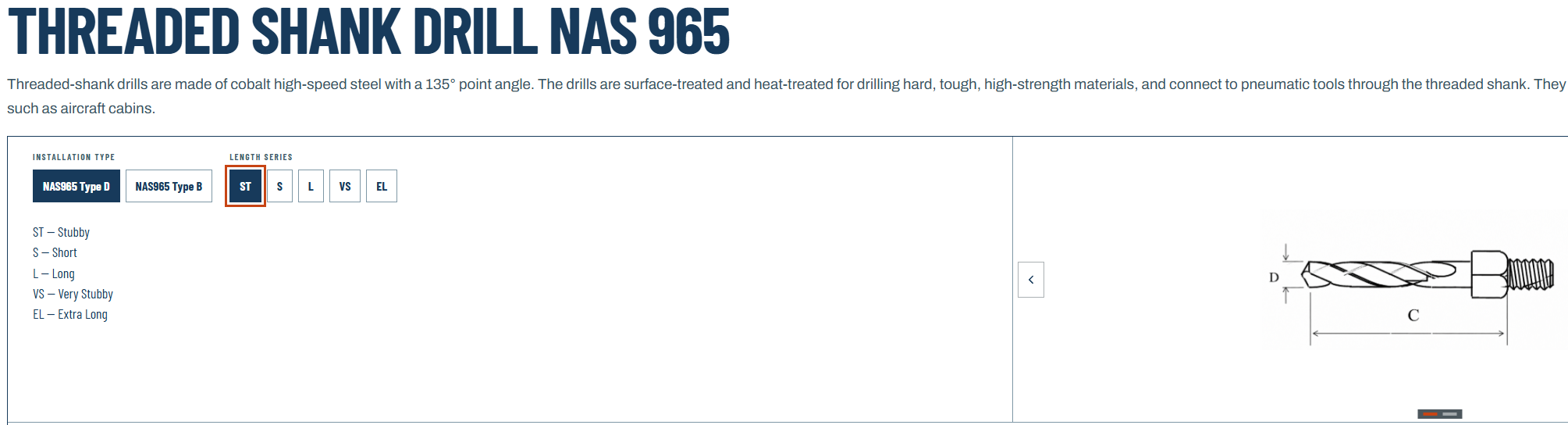
NAS965 drills are designed for confined working areas. The threaded-shank drill is secured in a pneumatic or similar drilling tool, making it especially suitable for drilling inside aircraft cabins, vehicle engine compartments, and other spaces where access is limited.
The NAS965 threaded-shank drill is available in five length series. ST, S, and L are the three most commonly used options. How should you choose among them for an actual application?
How long is each length series for the same drill size?
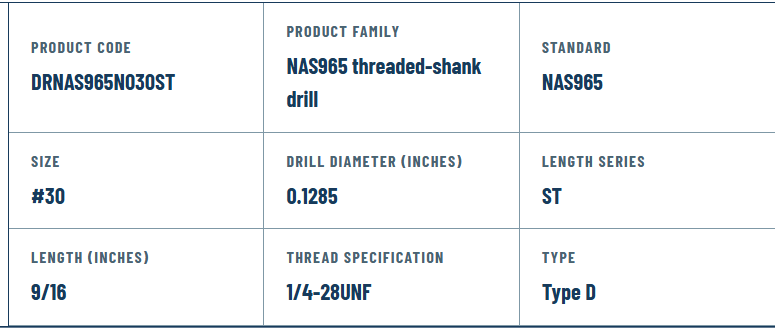
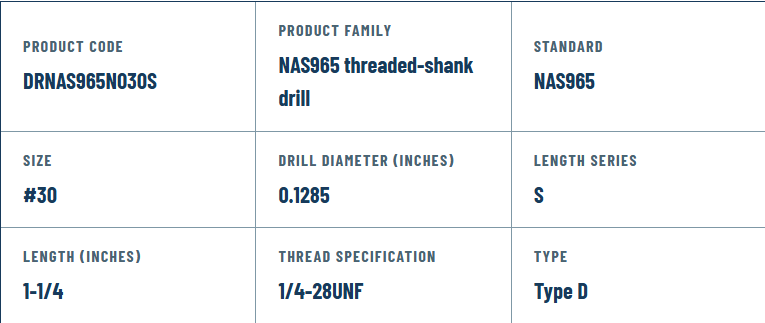
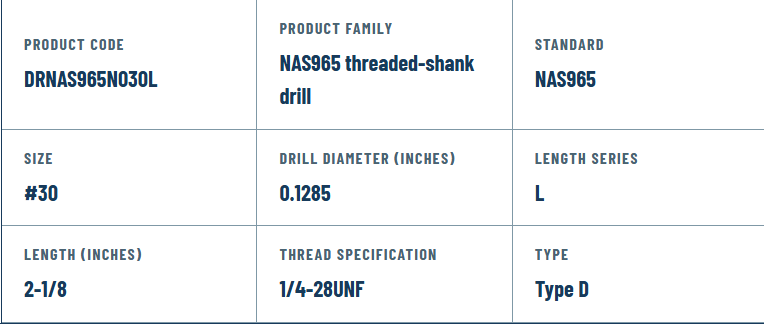
Why is flute length a key specification?
For holemaking with a twist drill, flute length is a critical specification. The helical flutes carry metal chips out of the hole. If the hole is deeper than the flute length, chips cannot evacuate properly and drilling performance will be affected.
Recommended drilling depth = flute length − 1.5 × drill diameter
Take size #30 as an example. The dimensions above show overall lengths of 9/16 inch for ST, 1-1/4 inch for S, and 2-1/8 inch for L. Our manufacturing data gives corresponding flute lengths of 5/16 inch, 9/16 inch, and 1-1/8 inch. Flute length is measured from the drill point to the end of the flute. The theoretical drilling depths are:
- 5/16 − 1.5 × 0.1285 ≈ 0.12 inch#30 NAS965 ST
- 9/16 − 1.5 × 0.1285 ≈ 0.37 inch#30 NAS965 S
- (1-1/8) − 1.5 × 0.1285 ≈ 0.93 inch#30 NAS965 L
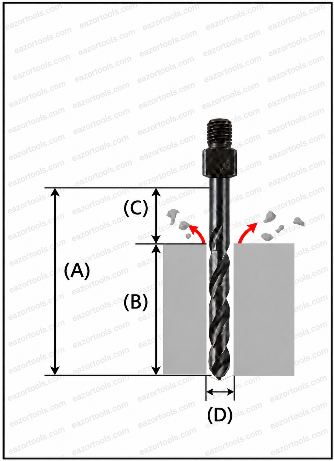
- A
- Flute length of the threaded-shank drill
- B
- Available drilling depth
- C
- 1.5 × D, the allowance required for chip evacuation
- D
- Diameter of the threaded-shank drill
For example, with a flute length of 50 mm and a drill diameter of 4 mm, the available drilling depth is 50 − 4 × 1.5 = 44 mm.
How should you choose between ST, S, and L?
Flute length and drill diameter determine the available drilling depth, while overall drill length determines the clearance between the pneumatic tool and the hole. If the tool can approach the hole closely, as when drilling aircraft skin, an S or ST length may be suitable. In a confined space where the tool must remain farther from the hole, or where the hole sits inside a recess, choose an L or an even longer NAS965 drill.
View NAS965 dimensionsAuthor: Simmons Wu, a mechanical engineer and electronics enthusiast
All rights reserved
Please credit the source when reproducing this article