
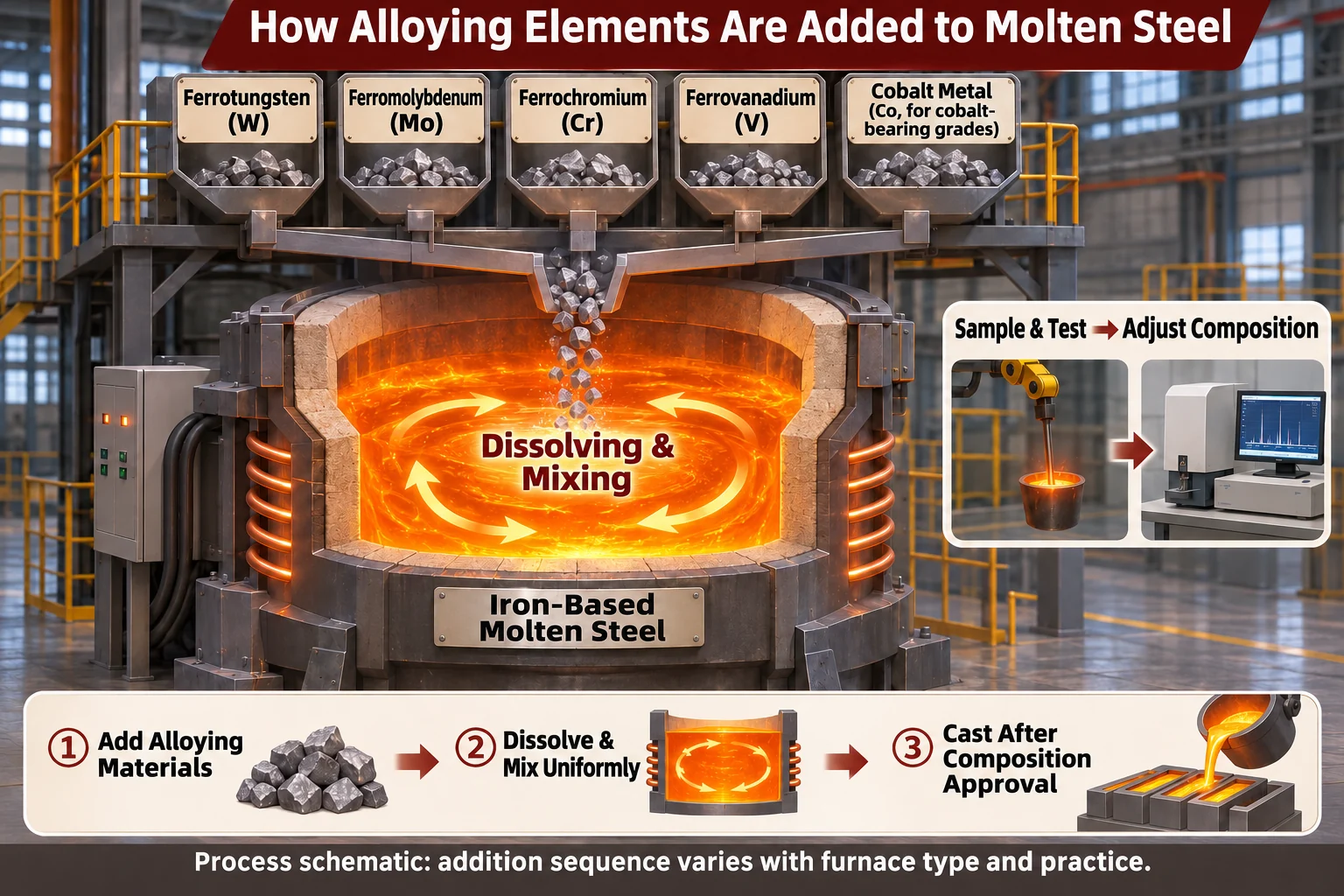
In CNC cutting tools, especially drills, high-speed steel (HSS) remains one of the essential material families. During steelmaking, alloying elements such as tungsten, molybdenum, chromium, vanadium and carbon are added to the molten steel. After the composition is verified, the steel is cast into ingots and then forged or rolled into bar stock for drill production.
How do M2, M35 and M42 differ?
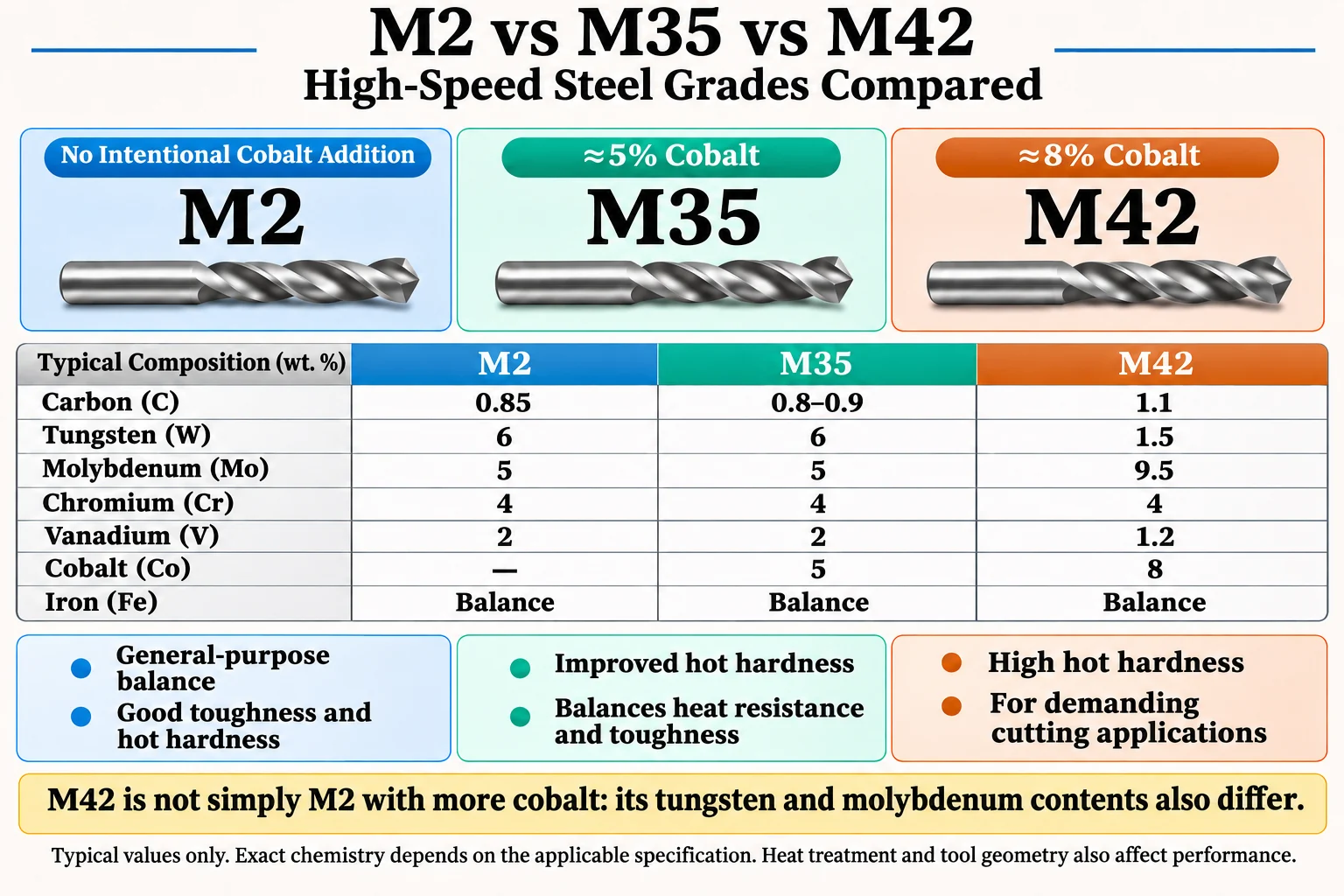
M2, M35 and M42 are all high-speed steel grades. The easiest distinction to remember is that M2 normally has no intentional cobalt addition, M35 contains about 5% cobalt, and M42 contains about 8% cobalt. Their differences extend beyond cobalt, as shown by the typical compositions below.
| Primary element | M2 | M35 | M42 |
|---|---|---|---|
| Carbon (C) | about 0.85% | about 0.8%–0.9% | about 1.1% |
| Tungsten (W) | about 6% | about 6% | about 1.5% |
| Molybdenum (Mo) | about 5% | about 5% | about 9.5% |
| Chromium (Cr) | about 4% | about 4% | about 4% |
| Vanadium (V) | about 2% | about 2% | about 1.2% |
| Cobalt (Co) | Normally not added | about 5% | about 8% |
How should you choose among them?
Based on composition and operating characteristics, the three drill materials can be summarized as follows:
M2
The most widely used drill material. It is economical and readily available, with a balanced combination of hardness, toughness and wear resistance.
M35
About 5% cobalt improves hot hardness, allowing the tool to retain hardness more effectively when cutting generates noticeable heat.
M42
Provides higher hot hardness and wear resistance, helping the tool retain hardness when machining more demanding materials.
Author: Simmons Wu, a mechanical engineer and electronics enthusiast
Published: November 4, 2026
All rights reserved
Please credit the source when reproducing this article